
Berlin climate-tech startup Kalz scales up CO2 storage and use in cement, backed by IBB Ventures
With an investment from IBB Ventures, Kalz GmbH is building one of Europe’s largest CO2 mineralization plants to produce building materials in Berlin: this technology enables lower-emission, cement-like materials. The plant is scheduled to go into operation later this year.
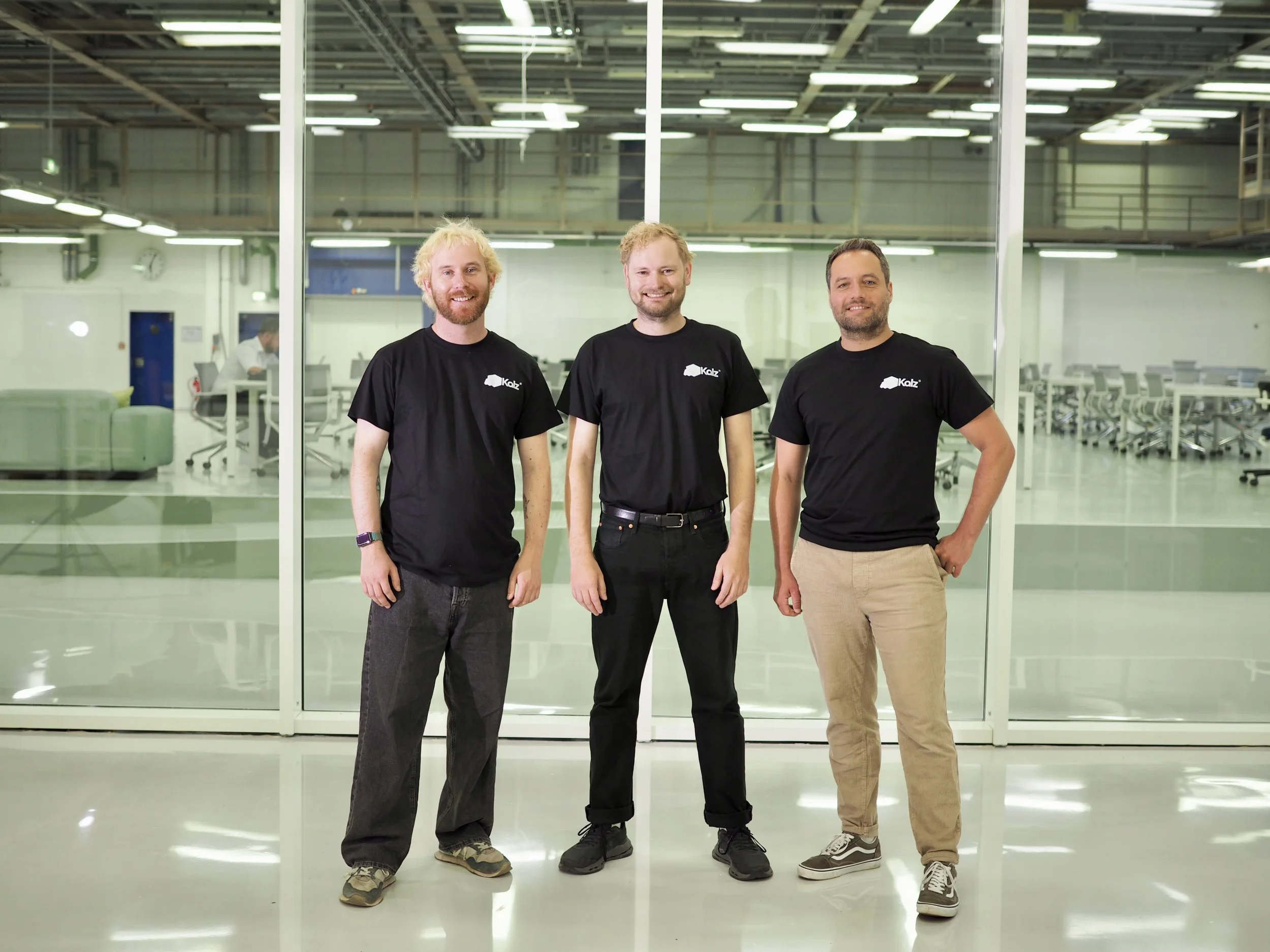
The Kalz founding team Dr. Jason Collis (CRO), Dr. Till Strunge (CEO), Dr. Dario Kremer (CTO) (left to right) at the new production site (photo: © Amelie Zink)
Berlin, 24 July 2026. The Berlin-based climate-tech company Kalz GmbH permanently converts CO2 into mineral building materials, opening new opportunities for broad decarbonization as well as for unlocking the economic usability of CO2. An investment from IBB Ventures now enables the construction of one of Europe’s largest CO₂ mineralization plants in Berlin. The investment is made as part of IBB Ventures’ B# (be sharp) programme.
Prior to the current financing round, Kalz had already secured €1.3 million in public funding to develop the technology and bring it to market maturity. These funds came from the VIP+ validation programme of the German Federal Ministry of Research, Technology and Space (BMFTR), under which the core process was scientifically validated and further developed to application readiness in the “Seq-Kalz” project at the Technical University (TU) Berlin. With IBB Ventures on board, the company is now moving toward industrial scale: later this year, one of the largest mineralization and production plants of its kind in Europe is set to go into operation.
CO2 mineralization: storage through use in the construction industry
In an accelerated process, industrial, CO2-rich exhaust gas reacts with mineral residues such as industrial slag or waste-incineration ash – materials that are usually landfilled or only reused in low-grade applications. In doing so, the CO2 is effectively “turned to stone”; more precisely, as powdery carbonate it is permanently bound and stored in chemical form. At the same time, the reaction upgrades the residue slag or ash used: from a waste product, a stable, carbonated material is created that can replace emission-intensive components in cement and concrete. It is the CO2 that makes the residue usable for the cement industry in the first place. In this way, Kalz combines the permanent storage of CO2 with the production of sustainable building materials that the construction industry can use directly, achieving a twofold effect: the carbon dioxide no longer enters the atmosphere but is stored over the long term, while at the same time providing a genuine alternative to conventional, emission-intensive cement and concrete.
Quote Kalz
“In our collaboration with partners from industry and research, it is becoming clear that wherever CO2 is generated in industrial processes, the need for practical ways to manage those emissions is growing. That's exactly what our technology addresses — and it does two things at once: we capture CO2 permanently and turn it into building materials that can stand in for the most emission-heavy ingredients in cement and concrete, ready for industry to use right away. With IBB Ventures now backing this approach, we have the foundation to bring it to industrial scale.”
— Till Strunge, CEO, Kalz GmbH
Quote IBB Ventures
“Kalz impresses us with a team that is tackling one of the most pressing challenges of our time, both technologically and entrepreneurially. Permanently binding CO2 in building materials holds enormous potential to scale, while creating value from several sources at once: the storage of CO2, the upgrading of industrial residues, and the global building-materials market. This makes the business model both robust and adaptable. The new plant in Berlin is only the beginning, and we're delighted to support Kalz on this path through B#.”
— Stephan Schulze, Investment Director, IBB Ventures
About IBB Ventures and B#
Through its pre-seed fund B# – “be sharp” – IBB Ventures is investing a total of €10 million in deep-tech ventures during the particularly challenging early phase. With ticket sizes between €100,000 and €400,000, the fund is aimed specifically at teams with scalable and innovative deep-tech approaches such as AI, quantum technologies, industrial software solutions, robotics, environmentally and resource-friendly technologies as well as biotechnologies, including innovative processes for medicine, health and sustainability. Because returns from exits are reinvested, the result is a model that lastingly strengthens the innovative power of Berlin’s deep-tech sector. B# is financed from European Union funds under the ERDF programme STEP (Strategic Technologies for Europe).
About Kalz
Kalz GmbH is a Berlin-based deep-tech company that has emerged from years of research into CO2 mineralization. It was founded by three scientists – Dr. Till Strunge (CEO), Dr. Dario Kremer (CTO) and Dr. Jason Collis (CRO) – building on the core process they validated scientifically in the federally funded "Seq-Kalz" project. Kalz transforms CO2 and industrial residues into durable, cement-based building materials, locking the carbon away permanently in the process. In this way, the company links the long-term removal of CO2 with the decarbonization of the construction sector, with the goal of bringing mineralization to industrial scale. Kalz has received several awards for its approach: as one of the “Top 100 Science Start-ups to Watch” of the Falling Walls Foundation (2026), as winner of the Tomorrow Accelerator of the Berlin Innovation Agency, and as a finalist of MassChallenge.
